
This service is often called valuation as of a past date or retrospective valuation. In everyday speech, people may also call it “backdated valuation”. But it is important to clarify this from the beginning: this is not about falsifying a document or preparing a report as if it had been issued earlier.
The valuation report is prepared now, on the date when the client requests the service, but the market value in the report is determined as of a specific date in the past. This is a normal and legal valuation procedure, provided that it is carried out professionally, with the correct indication of the valuation date, the purpose of the work, the sources of information and any limitations.
Such work is always more complicated than a regular property valuation as of the current date. The valuer does not simply look at how much similar property is worth today. They need to reconstruct the market situation as it existed at the point in time that matters for the client, the court, a tax adviser, an accountant or another institution.
How valuation as of a past date differs from a regular valuation
In a regular valuation, the valuer analyses the market as of today or as of a date close to the date of the report. They look for current offers for sale or rent, compare them with the subject property, and take into account the area, condition, location, floor level, building type, use of the premises and other important characteristics.
When the value has to be determined as of a past date, the general approach remains similar, but the sources of information become much more difficult to work with. The valuer has to find not just comparable assets, but offers or market data that were relevant during the required period.
For example, if an apartment is valued as of 2018, real estate listings from 2026 cannot directly show its value in 2018. It is necessary to search for archived advertisements, old market reviews, price statistics, saved website pages or other sources that help show what the market looked like at that time.
In practice, this information is not always complete. Some advertisements disappear, photos may no longer open, addresses may be hidden, the description of the condition may be very short, and sometimes it is impossible to know for sure whether the property was actually sold or merely advertised for a long time at an inflated price.
For this reason, valuation as of a past date almost always takes more time than a regular valuation. This is especially true if the date is many years in the past or if the asset has specific characteristics: an unusual layout, poor technical condition, commercial use, a rare model, a special location or a limited number of comparable items.
How the valuer searches for value in the past
The best situation is when it is possible to find a sufficient number of archived offers for the sale or rent of similar property on or around the required date. For example, if the task is to determine the value of an apartment in Kyiv as of 2020, the valuer looks for offers of similar apartments in the same district, in buildings of a similar class, with a comparable area, floor level and condition.
For real estate valuation, such sources may include old listings, website archives, market reviews, agency data, publications on price dynamics or other information that can be used to justify the value. For cars, this may include data from specialist vehicle valuation guides for the relevant period or archived offers for vehicles of the same make, model, year of manufacture, mileage and trim level. For equipment, the valuer may look for information about the sale of similar assets, their technical condition, year of manufacture, wear and demand in the relevant market. It is also very helpful if the valuer already has experience with similar property as of a close date or has preserved market data for the required period.
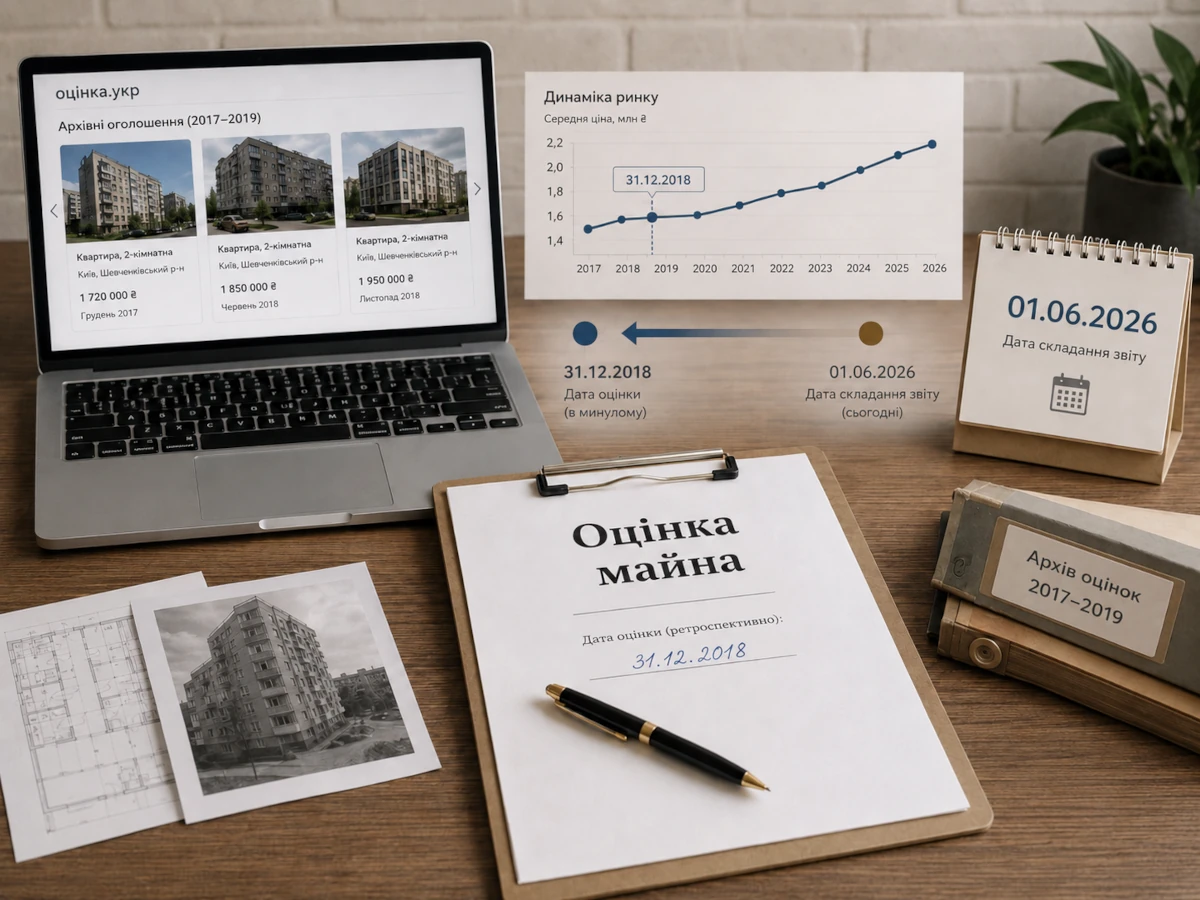
However, direct archived comparables are not always available in sufficient numbers. In such cases, one possible solution is to determine the value of the asset as of the current date and then move back to the past date using coefficients that reflect changes in the market. In other words, the valuer first understands how much such an asset would be worth today, and then analyses how the value of this specific type of asset changed over the required period.
At first glance, this may seem simple. In reality, this is where many professional issues arise. It is not enough to take an average real estate price index and apply it mechanically to any object. The markets for apartments, private houses, land plots, offices, warehouses, vehicles and equipment change in different ways. Even within one city, prices for older housing, new developments, commercial premises and garages may move very differently.
That is why it is important not only to find a coefficient, but also to justify why it is appropriate for this particular type of asset, in this particular location and with these particular characteristics. If this is not done, the result may look unconvincing and may raise questions from the court, tax authority, auditor or foreign institution.
Most often it is real estate, but not only real estate
The most common request is real estate valuation as of a past date or retrospective valuation of real estate. It may relate to an apartment, residential house, land plot, garage, office, shop, warehouse, industrial premises or another type of property.
For example, a person may need to confirm the value of an apartment in Ukraine for a foreign tax declaration. Or a court may be considering a property division case, and it is necessary to determine how much an apartment, house or car was worth on a specific date.
For residential property, clients often need an apartment valuation as of the date of purchase, sale, gift, opening of inheritance, actual separation of spouses or another date that matters in a specific case. Sometimes even a difference of several years is very significant, because the market may have grown noticeably or, on the contrary, declined.
But valuation as of a past date is needed not only for real estate. In divorce-related court disputes, it is often necessary to determine the value of a car as of the date when it was purchased or sold. For example, one spouse may have sold the car before the dispute was resolved, while the other spouse believes that the proceeds should be taken into account when dividing the joint property. In such a case, the car may need to be valued not as of today, but as of a specific date in the past.
Another major area is accounting and tax audits. A company may need to determine the historical value of fixed assets, equipment, vehicles, furniture or other property in order to support accounting entries, correct errors, document the value of assets or prepare explanations for controlling authorities. In such cases, retrospective valuation may be relevant for fixed assets, equipment and other business property.
Why valuation as of a past date may be needed
The reasons may vary, but in practice this type of valuation is most often needed in two situations: for submitting documents abroad and for court disputes. Both cases have their own specifics, and in both cases mistakes in the valuation may cost the client much more than the valuation service itself.
Valuation of real estate in Ukraine for submission abroad
One of the most common modern requests is the valuation of real estate in Ukraine for use abroad. For example, a person lives in another country, files a tax declaration, applies for social benefits, confirms the origin of funds, declares foreign assets or explains the sale of Ukrainian property.
In such situations, a foreign authority, tax adviser, accountant or lawyer may request a document confirming the value of an apartment, house, land plot or other property in Ukraine as of a specific date. This may be the date of purchase, the date of moving to another country, the date of obtaining tax resident status, the date of sale or another date that matters under the rules of the relevant country.
Such work should be treated with particular care. In many countries, tax authorities take information about foreign property seriously. A poorly prepared, overvalued or undervalued valuation may create problems not only with the documents themselves, but also with explaining the origin of funds, calculating taxes or confirming the reliability of the information submitted.
For this reason, when a report is prepared for use abroad, the calculation of value is only one part of the work. The format of the report also matters. Usually, the document should clearly state the purpose of the valuation, the date as of which the value is determined, the description of the property, its photographs, the sources of information used and the logic of the calculation.
Part of the report or certain key sections may be translated into English. The value is often additionally shown in the equivalent currency of the country where the documents will be submitted. For example, if a Ukrainian apartment is valued for submission in the United Kingdom, Canada, Germany or another country, it may be more convenient for the client to see not only the value in Ukrainian hryvnia, but also the equivalent in pounds, euros, dollars or another currency.
Valuation for court in property division cases
The second common area is valuation for court. Most often, it concerns disputes between spouses, inheritance conflicts, compensation for a share in property, or determining the value of assets that one party has already sold or transferred to someone else.
In the division of marital property during divorce, it is not enough to name an approximate price of an apartment, car or other asset. It is important to understand the exact date as of which the court needs the value. In some cases, this may be the current date. In others, it may be the date of acquisition of the asset, the date of sale, the date when the spouses stopped living together, or another date determined by the circumstances of the case.
For example, a car was purchased during the marriage but sold by one spouse before the court dispute was resolved. In order to determine fair compensation, the question may arise: how much was this car actually worth on the date of sale? Or another situation: an apartment was purchased many years ago, part of the money was contributed by one spouse before the marriage, and the parties need to understand the ratio of the value of the property at different dates.
Why this is not a “backdated fake document”
Because of the everyday phrase “backdated valuation”, clients sometimes get the wrong impression that the valuer is supposed to prepare a document as if it had been issued several years ago. That is not the case.
A lawful valuation as of a past date means something different: the valuer prepares the report today, but states that the market value is determined as of a specific date in the past. In other words, the date of the report and the valuation date may be different. This is normal, provided that it is clearly stated in the document and corresponds to the purpose of the valuation.
A professional report must not imitate an old date, hide the actual date of preparation or substitute documents. On the contrary, the more complex the situation is, the more transparent the report should be about the sources used, the assumptions made, the completeness of the market data and the limitations of the result.
We are often asked whether a retrospective valuation must be registered in the Unified Database of Valuation Reports of the State Property Fund of Ukraine. If the report is prepared for court, accounting purposes or submission abroad, the answer is simple — no. First, this is not required by law if the valuation is not used to determine the taxable income of an individual. Second, the report is prepared now, while the value in it is determined as of a past date, so it is technically impossible to register it in the Unified Database “as of a date in the past”.
What documents and information should be prepared
For valuation as of a past date, the same basic documents are usually needed as for a regular valuation: ownership documents, technical documentation and, if available, photographs of the asset. It is also necessary to provide the exact date as of which the value has to be determined.
If an apartment is valued as of a specific year, it is helpful to know what condition the renovation was in at that time, whether there was furniture, whether the area changed after redevelopment and whether any major improvements were made later.
If a car is valued, important information includes the date of purchase or sale, mileage as of the relevant date, trim level, technical condition, accident history, repairs or significant damage. For equipment or fixed assets, the important details include the year of manufacture, manufacturer, model, intensity of use, technical condition, remaining useful life, and documents on repair or modernization.
Sometimes the client has old photos, contracts, sale advertisements, inspection reports, insurance documents or accounting certificates that help show the condition of the asset at a certain point in time. Such materials can also be very useful.
Why this valuation is more difficult and more expensive than a regular one
A regular valuation as of the current date usually relies on a more accessible market: current advertisements, open offers, fresh data and a relatively clear picture of supply and demand. In a valuation as of a past date, the valuer effectively has to return to the period for which the market picture needs to be reconstructed.
The difficulty is not only in finding archived advertisements. The valuer also has to check whether they really relate to similar property, whether the prices were inflated, whether the description of the object matches the required segment, and whether these data can be used without significant adjustments. If a coefficient of value change is used, it also has to be justified, not simply taken from the first chart found online.
That is why a responsible valuer cannot always immediately name the exact price of the service or promise that the result will be ready as quickly as a regular apartment valuation as of today. First, it is necessary to understand the required date, the asset being valued, who the document is being prepared for, and how realistic it is to collect reliable market information.
Sometimes there is enough archived data, and the work proceeds relatively smoothly. In other cases, the date is very old, the market is narrow, the object is unusual, and the available sources contradict one another. In such a situation, valuers may simply refuse to take on the assignment because there is objectively no way to perform it properly.
To sum up
Valuation as of a past date is not a formality and not a “backdated paper”. It is full professional work in which the valuer has to reconstruct the market situation at a specific moment in the past, select or reasonably use archived data, correctly describe the sources of information and make a clear calculation.
Most often, this service is needed for real estate, but in practice it may also apply to vehicles, equipment, fixed assets, corporate rights and other property. Reports intended for use abroad require particular attention, because not only the numbers matter, but also the translation of certain pages into a foreign language, the indication of the equivalent amount in the currency of the country where the documents are submitted, the valuation date and the overall quality of the work.
If you need to determine the value of property in Ukraine as of a past date — for court, a foreign tax declaration, accounting purposes or another official purpose — it is better to contact valuers who already have experience with this type of work. We understand the specifics of valuations as of past dates, work with different types of property and can prepare a report taking into account the purpose for which it will be submitted. We will be happy to cooperate!